
How Much Space Do You Need Around a Bed? A Practical UK Bedroom Layout Guide
Published Last updated
A bed can fit inside a bedroom and still make the room difficult to use. You might have to turn sideways to get past the footboard, squeeze between the bed and wardrobe, or discover that a drawer cannot open fully.
Before choosing a bed size, measure the finished bed frame and the space you’ll need to use everything around it. Here’s a straightforward way to work it out.
The short answer
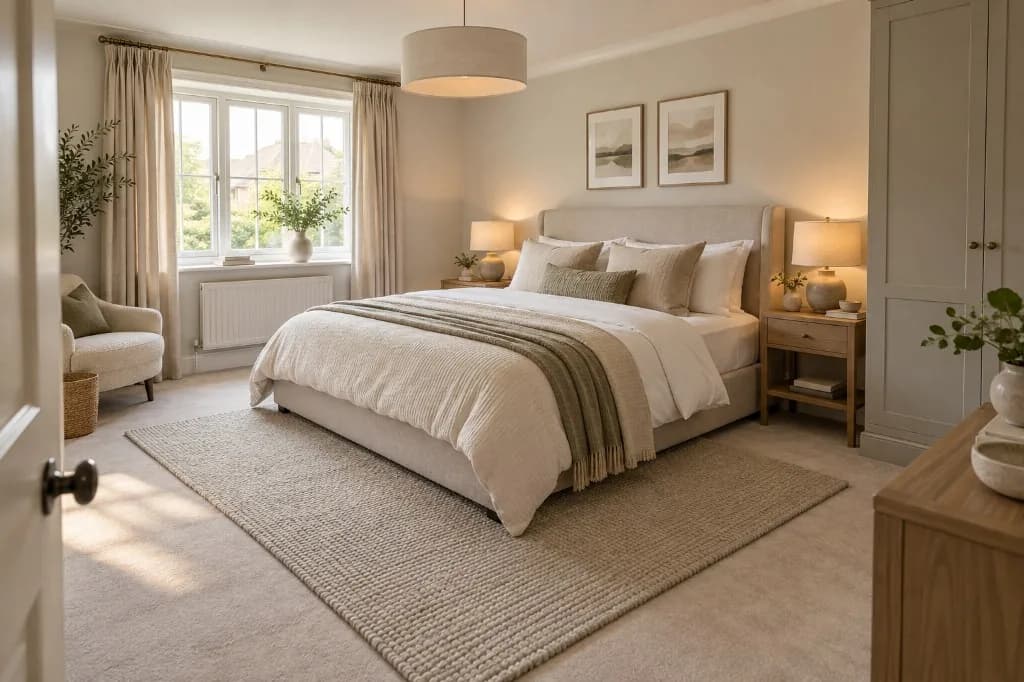
As a planning starting point, aim for around 60 cm of clear space on each side of the bed that someone regularly uses. If the room allows it, approximately 75 cm will feel less restricted. At the foot, allow space for the route you actually take—particularly if you walk past it to reach a door or wardrobe.
These are useful guides, not rules that work in every room. A single sleeper may be happy with one side against a wall. Two people sharing a bed will usually want access to both sides. A wardrobe door, drawer or storage bed may need more space when it is open than the walkway needs when it is closed.
The quickest test: measure your room, find the bed’s outer dimensions on its product page, and mark its footprint on the floor with masking tape. You can do the same check in the Bed Size & Room Fit Calculator, moving the bed against your door, wardrobe and tables. Then open the bedroom door and every nearby wardrobe door or drawer.
Measure the frame, not just the mattress
UK mattress sizes give you a starting point:
| UK mattress size | Standard mattress dimensions |
|---|---|
| Single | 90 × 190 cm |
| Small double | 120 × 190 cm |
| Double | 135 × 190 cm |
| King | 150 × 200 cm |
| Super king | 180 × 200 cm |
Those are mattress dimensions, not promises about the space a bed frame will occupy. Side rails, a padded headboard, wings or a substantial footboard can make the finished bed wider or longer. A TV bed’s footboard deserves particular attention when you calculate the route past the end.
Before you order, note the product’s overall width, overall length and headboard width. If it has storage, check which way it opens. Our UK Bed Size Guide can help you compare the mattress sizes; use the individual product dimensions for your room plan.
How to calculate the space around your bed
Start with the wall you want the headboard against.
- Measure the usable width of the room at the bed’s position.
- Subtract the bed frame’s overall width.
- Divide what remains between the left and right sides according to how you use the room. The bed does not have to be perfectly centred.
- Measure the room length and subtract the frame’s overall length to find the space at the foot.
- Repeat the check with nearby doors, drawers and storage compartments fully open.
For example, imagine a 3 m × 3 m room and a king bed frame measuring 160 × 210 cm overall. These frame dimensions are an illustration, not the dimensions of every king bed, and they are not a Bedwick product specification.
Across the room, 300 − 160 = 140 cm remains. With the bed centred, 140 ÷ 2 = 70 cm on either side. Along the room, 300 − 210 = 90 cm remains at the foot.
On an empty floor plan, that looks workable. Now put the real room back into the calculation. If a 60 cm deep wardrobe occupies the wall at the foot, only 30 cm remains between its closed front and the bed: 300 − 210 − 60 = 30. Its doors or drawers may reduce that space further. The king bed fits inside the room, but that particular layout does not work well.
How much space do you need between a bed and a wardrobe?
Measure from the outer edge of the bed frame to the front of the wardrobe, then test the wardrobe in use. With hinged doors, open a door fully and check whether you can stand in front of it and reach the contents. With drawers, pull one out to its full depth. Sliding doors avoid a door swinging into the room, although you still need space to stand and use the wardrobe.
Here is another example. In a room 340 cm long, a 210 cm long bed frame and a wardrobe 60 cm deep on the opposite wall leave 70 cm between their closed fronts:
340 − 210 − 60 = 70 cm
That is a useful closed-door measurement. Whether the layout feels comfortable depends on how the wardrobe opens and how often you need to pass it.
Where should the bed go?
The simplest starting point is a wall that lets you reach the sides you need while leaving a clear route to the door. Then test the room’s fixed features:
- Bedroom door: Check its complete swing, including the handle.
- Window: Make sure you can still reach curtains or blinds. Consider whether the headboard blocks light or sits against a radiator.
- Wardrobe and drawers: Test them fully open, not just as rectangles on a floor plan.
- Bedside tables: Check the space at their exact position; they occupy part of the side clearance even when the rest of the walkway is open.
- Alcoves, chimney breasts and sloping ceilings: Measure at the height where the bed or headboard will actually sit.
You may find that shifting the bed slightly to one side produces a better room than centring it. The question is whether the people using the bed can get in and out comfortably and whether the important furniture still works.
What changes for an ottoman, drawer or TV bed?
A storage bed can help you avoid an extra piece of furniture, but its storage must be accessible.
For an ottoman bed, check whether the mattress platform lifts from the side or the foot. Test the opening area and the height above it, especially under a sloping ceiling. For a drawer divan, allow enough room to pull out the drawer and reach inside; a drawer against a wall or tightly beside another piece of furniture may offer little practical storage. Our storage bed guide compares those opening directions.
For a TV bed, check the overall frame length, including the footboard. Look at the space between the footboard and whatever faces it. Our Ottoman Bed Storage Calculator can help you think about storage capacity, while the room-fit check tells you whether you can comfortably use that storage.
Will a king bed fit in a 3 m × 3 m bedroom?
It can, but the answer depends on the frame and the furniture. The illustrated 160 × 210 cm frame leaves 70 cm on each side and 90 cm at the foot when centred in an otherwise empty 3 m × 3 m room. A different headboard or footboard changes those figures. A wardrobe on the foot wall, bedside tables, a door swing or a radiator can change the answer entirely.
If a king leaves the room difficult to use, compare a double before deciding. You gain 15 cm of mattress width difference between a UK double and king, but the usable space gained in your room depends on the actual frames you compare. Our Bed Frame Buying Guide covers the other decisions—style, support and storage—once you know what fits.
Test your own room before you choose
You do not need to rely on a generic “minimum bedroom size.” Put your room measurements and furniture positions into Bedwick’s Bed Size & Room Fit Calculator. Move the bed, door, wardrobe and side tables around, and compare the clearances for different bed sizes.
Then check the outer dimensions of the Bedwick bed you like against your final layout. A few minutes spent on the real measurements is far more useful than finding out after delivery that a wardrobe drawer cannot open.
Frequently asked questions
It is a common starting point for a side someone uses regularly. More space may feel better, and a bedside table or opening drawer can change what is usable at a particular point. Measure your own route rather than treating 60 cm as a guarantee.
A single sleeper can sometimes place one side against a wall. If two people share the bed, access on both sides is usually more practical, particularly for getting up at different times and changing bedding.
Use the outermost part of the bed, including any wide headboard or projecting footboard. Mattress measurements are useful for comparing UK sizes, but they do not describe every frame’s full footprint.
Yes, provided you can open it and reach the storage. Check the lift direction, nearby furniture and ceiling height. The storage may replace a chest of drawers, but its opening space still matters.
Draw or mark the usable floor area, including alcoves, radiators and door swings. Try more than one bed position. A slightly smaller bed or a different storage opening direction may make the entire room easier to use.
Related guides
 FeaturedBuying Guides
UK Bed Size Guide
Every UK size in cm and feet, why a bed frame is bigger than its mattress, and how to check it fits your room.
Read article FeaturedBuying Guides
Bed Frame Buying Guide
A practical guide to choosing a bed frame in the UK — room measurements, mattress sizes, storage types, base compatibility, delivery access and what to check before you order.
Read article Guides
Storage Bed Guide
Maximise bedroom storage with ottoman beds, drawers, and blanket boxes.
Read article