
UK Bed Size Guide: Single, Double, King & Super King Dimensions
A king size mattress measures 150 × 200cm. The frame it sits in almost never does — ours works out closer to 157 × 218cm once you account for the side rails and headboard. That gap is where most bedroom measuring goes wrong.
Choosing a size is a trade-off between three things: how much sleeping width you actually want, what your room can take once you’ve allowed for wardrobe doors and walking space, and whether the mattress and bedding you already own will still fit. Bigger isn’t automatically better. A super king in a three-metre room leaves you edging sideways past the footboard every morning.
This guide covers all five standard UK sizes in centimetres and feet, explains where frame dimensions differ from mattress dimensions, and shows you how to work out what your room will hold. You can also check which bed size fits your room with the Bedwick planner.
UK Bed Sizes at a Glance
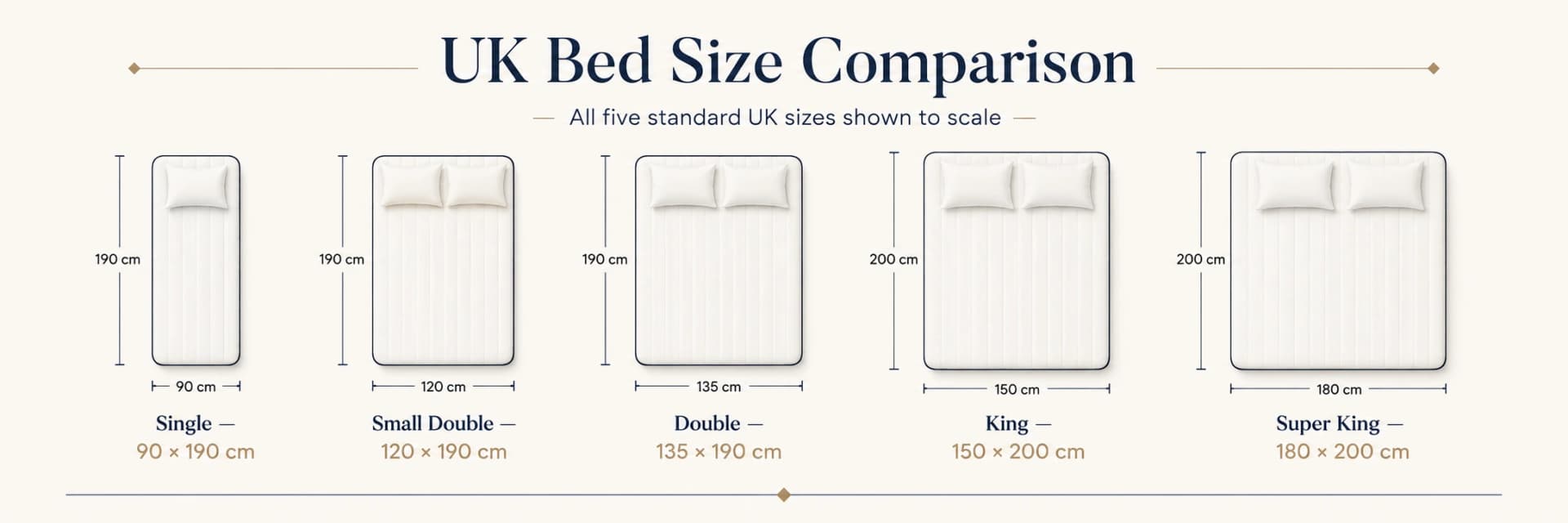
Standard UK mattress sizes
| Bed Size | Width | Length | Feet & Inches | Best suited to |
|---|---|---|---|---|
| Single | 90cm | 190cm | 3ft × 6ft 3in | One sleeper — children, teenagers, guest rooms, box rooms |
| Small Double | 120cm | 190cm | 4ft × 6ft 3in | One sleeper wanting more room; two at a squeeze |
| Double | 135cm | 190cm | 4ft 6in × 6ft 3in | Two sleepers in an average bedroom; the UK's most common couple's size |
| King | 150cm | 200cm | 5ft × 6ft 6in | Two sleepers with more room, and anyone over about 6ft |
| Super King | 180cm | 200cm | 6ft × 6ft 6in | Two sleepers wanting the most width; larger rooms only |
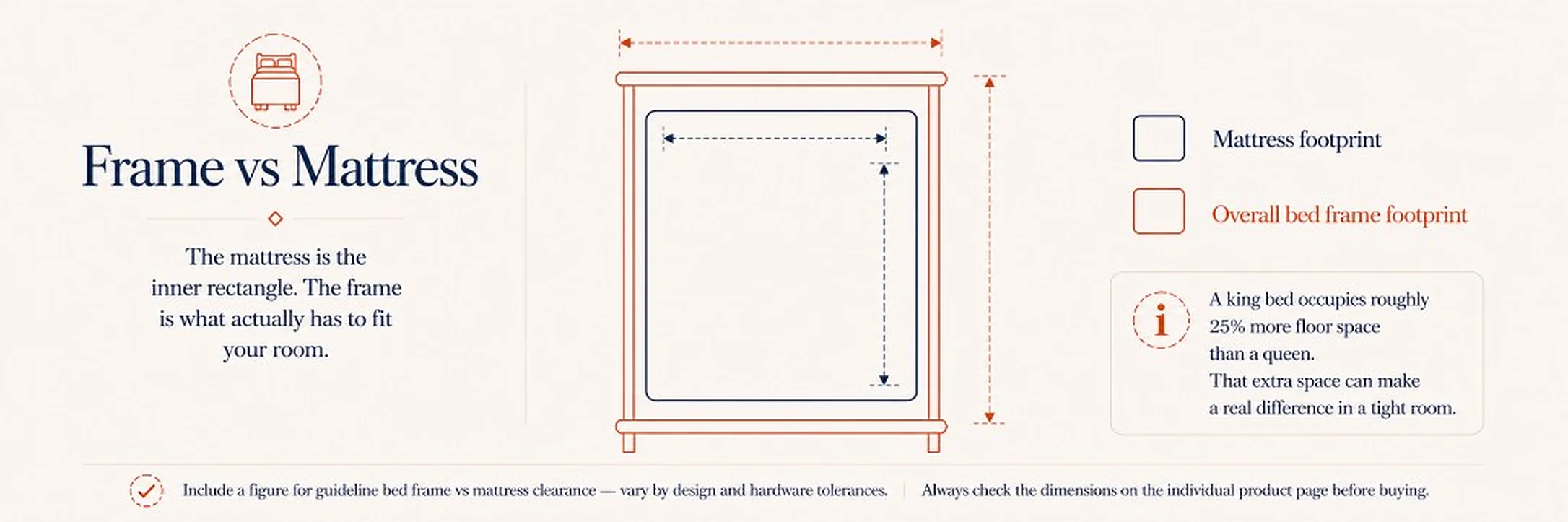
These are mattress measurements, not bed measurements. Every figure in the table above describes the sleeping surface — the mattress footprint. A complete bed frame is larger, because side rails, upholstery, a headboard and any footboard or wings all sit outside the mattress. How much larger depends entirely on the design, so always check the dimensions listed on the individual product page before you commit.
One other thing worth knowing: the imperial names are traditional trade labels, rounded for convenience rather than converted precisely. A “3ft” single is actually 2ft 11.4in. A “4ft 6in” double is 4ft 5.1in. Nobody in the trade minds, but if you’re measuring to the centimetre, use the metric figures.
What Size Is a Single Bed?
A UK single mattress is 90 × 190cm, or 3ft × 6ft 3in.
It’s the sensible default for children’s rooms, teenagers’ rooms and guest rooms. One sleeper gets 90cm of width, which suits most adults who sleep alone.
The real argument for a single is floor space. At 90cm wide it leaves room for a desk, a chest of drawers or a wardrobe in a bedroom where a small double would swallow the lot. In a box room or a loft conversion with sloped ceilings, that flexibility usually matters more than sleeping width.
One flag for taller teenagers: a single is 190cm long. If someone is close to six foot and still growing, length becomes the limiting factor before width does, and no amount of extra width fixes that.
You can browse our single beds to see the styles available in 3ft.
What Size Is a Small Double Bed?
A small double mattress is 120 × 190cm, or 4ft × 6ft 3in.
You’ll see it called a 4ft bedconstantly, and occasionally a “queen” — that second name causes real confusion, and we’ll come back to it.
The honest use case is a single sleeper who wants more room. At 120cm, one person has a generous amount of space, and the bed still fits a room that couldn’t take a double without feeling tight.
For two people, be realistic. A small double gives each sleeper 60cm — two-thirds of a single mattress each. Some couples are perfectly happy with that, particularly in a spare room or a flat where the alternative is no double at all. Plenty of others find it too close for a bed they sleep in every night. If it’s your main bed and you have the floor space, a double is usually the better call.
Have a look at our small double beds if 4ft is the size you’re working with.
What Size Is a Double Bed?
A double mattress is 135 × 190cm, or 4ft 6in × 6ft 3in.
This is the standard UK double, and the most common couple’s bed in the country. It’s the size most bedding, mattress protectors and fitted sheets are designed around.
Two sleepers get 67.5cm each — noticeably less than a single mattress apiece. A double works well for couples who don’t mind being close, and for anyone who sleeps alone and wants room to sprawl.
The thing people miss is the length. A double is 190cm long — the same as a single and a small double. Going from a small double up to a double buys you 15cm of width and no extra length at all. If your problem is feet hanging off the end rather than elbows in the ribs, a double won’t solve it.
Our double beds cover 4ft 6in across most frame styles.
What Size Is a King Size Bed?
A UK king mattress is 150 × 200cm, or 5ft × 6ft 6in.
Here’s the practical detail that gets overlooked: a king is both wider and longer than a double. Every size below king — single, small double, double — is 190cm long. King is the first step up to 200cm.
That extra 10cm of length is the single best reason to choose a king, and it has nothing to do with couples. If you’re around 6ft or taller, 190cm means sleeping with your feet at or over the edge, or curling up to avoid it. Ten centimetres sounds trivial written down. It isn’t, when it’s the difference between your heels on the mattress and off it.
On width, a king gives two sleepers 75cm each. Compared with a double’s 67.5cm, that’s a modest but real gain — roughly the width of a hand each side.
You can see our king size beds here.
What Size Is a Super King Bed?
A super king mattress is 180 × 200cm, or 6ft × 6ft 6in.
The width jump is substantial: 30cm more than a king, which works out at 90cm per sleeper — a full single mattress each.For couples who wake each other up, or who share the bed with children or a dog, that’s the meaningful difference. Length is identical to a king at 200cm.
Two things to check before ordering. First, the room: a super king frame is wider than the 180cm mattress suggests — ours measures around 188cm across — and you still need to walk past it and open drawers.
Second, the access route. The constraint is rarely the bedroom itself. It’s the turn at the top of the stairs, the landing, the doorway. Measure those, not just the wall the bed will sit against.
If the space is there, our super king beds are available across most designs.
UK Bed Size Comparison
The table gives you the numbers. What they mean is more useful.
- Single vs Small Double— 30cm of extra width, same 190cm length. For one sleeper, the difference between adequate and comfortable. It’s also the point at which a bedroom starts losing furniture options.
- Small Double vs Double — 15cm of extra width, same length. The smallest step in the range. It takes each person from 60cm to 67.5cm, and it gains you access to standard double bedding, which is far easier and cheaper to buy.
- Double vs King — 15cm wider and10cm longer. The most significant step in the range, because it’s the only one that changes the length.
- King vs Super King — 30cm of extra width, no extra length. Purely about sleeping width for two. If your complaint is being disturbed at night, this is the upgrade that addresses it. If your complaint is your feet, it changes nothing — you already had 200cm at king.
Double vs King: Which Should You Choose?
For most couples deciding between these two, it comes down to four questions.
How tall are you?
If either of you is around 6ft or over, the king’s 200cm length is the deciding factor and the width is a bonus. This is the clearest case for sizing up.
What will the room take?
A king frame needs roughly 157cm of wall, plus walking space, plus anything beside the bed. In a room where that leaves you 40cm to shuffle past the end, a double you can move around beats a king you can’t.
What’s beside the bed?
Two bedside tables need around 45–50cm each. Fitting a king plus two tables into a room that comfortably held a double plus two tables is often where the plan falls apart.
Do you already own a mattress?
A double mattress will not work on a king frame, or the reverse. If your mattress is newish and you’re only replacing the frame, staying at your current size saves a significant cost — and larger bedding is the expense people forget to price in.
King vs Super King: Is the Extra Width Worth It?
If you’re already committed to 200cm of length, this is a straightforward question about width.
It’s worth it when you’re regularly disturbed by your partner moving, when children or pets end up in the bed, or when one of you is broad-shouldered enough that 75cm feels tight. Going to 90cm each is a genuine change rather than a marginal one.
It isn’t worth it when the room can’t absorb it. A super king that leaves no comfortable route around the foot of the bed is a downgrade in daily use, whatever it does for your sleep. It’s also worth checking the price of super king bedding before you decide — the range is narrower and the cost is higher than king.
How Much Space Should You Leave Around a Bed?
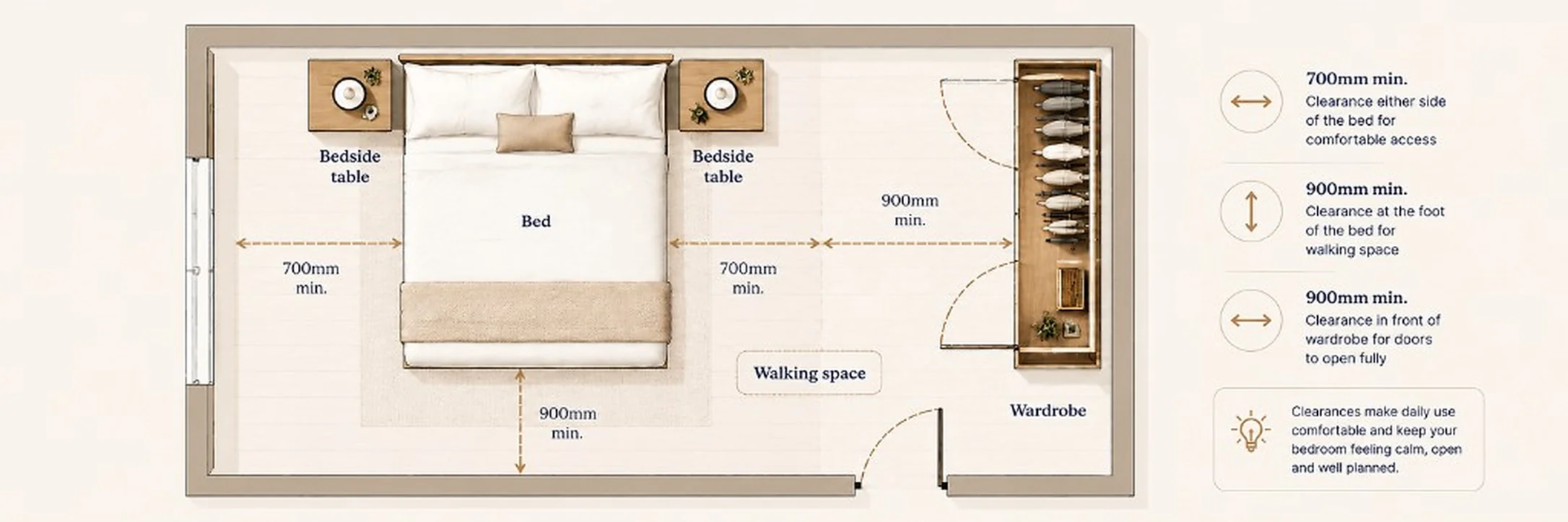
There’s no legal or official clearance figure, and any guide that gives you one precise number is guessing. What you can do is work backwards from what has to physically happen in the room.
- Walking space at the sides.Around 60cm lets an adult walk past comfortably. Below about 45cm you’re turning sideways. This is guidance drawn from ordinary use, not a standard.
- Space at the foot. Approximately 70cm or more generally makes movement easier when you walk past the end of the bed. These figures are practical planning guidance, not building regulations.
- Bedside tables. Typically 40–50cm wide, and they need to sit clear of the frame.
- Wardrobe and drawer clearance.A wardrobe door needs its full swing. A chest of drawers needs the drawer’s whole depth pulled out, plus you standing in front of it.
- Door swing. Check where your bedroom door opens to, and whether the bed will foul it.
- Radiators. A bed pushed against a radiator blocks the heat and is uncomfortable to sleep beside.
- Sockets and switches. A wider bed pushes bedside tables further along the wall, which can put your lamp or charger out of reach.
Then do the arithmetic with the framewidth, not the mattress. For a super king: roughly 188cm of frame, plus 60cm each side, needs about 3.08m of room width. Cut the clearance to 45cm a side and it’s 2.78m. Neither number is a rule — they’re just what the tape measure says.
For a longer walk-through, including a centred king frame in an empty 3 m square room and the gap a wardrobe leaves at the foot, read how much space you need around a bed.
One point specific to certain designs. An ottoman bed needs clearance for the base to lift, so keep the foot of the bed clear if it’s an end-lift. A TV bed needs space for the screen to rise at the footboard. Both are easy to overlook when you’re only measuring the floor.
How to Measure Your Bedroom Before Buying a Bed
- Measure the usable room, not the room. Width and length at floor level, then note anything that eats into it — a chimney breast, bay window, sloped ceiling, radiator, skirting.
- Get the complete product dimensions.Use the figures on the specific product page, which describe the assembled bed. Don’t work from the mattress size.
- Mark the footprint on the floor.Masking tape or newspaper, at the frame’s full dimensions. Leave it a day or two and walk the route you’d actually walk.
- Open everything.Wardrobe doors, drawers, the bedroom door. If anything catches the tape outline, it’ll catch the bed.
- Check the access route. Doorway width, hallway, and the turn at the top of the stairs — that turn defeats more deliveries than any other point in a house.
- Measure stairs and landingsif you’re above ground floor, noting the narrowest point and any tight corner.
- Account for the headboard and footboard. A headboard needs wall height as well as floor space — ours start at 137cm and go considerably higher as an option, which matters under a sloped ceiling. Footboards and wings add to the overall footprint.
- Check sockets, radiators and windows last.Confirm you can reach a plug, that curtains clear the bed, and that you’re not blocking a radiator.
Bed Size vs Mattress Size: Are They the Same?
No, and this is the most common misunderstanding in bed buying. Some retailers state that a frame and mattress simply match — that’s true of the fit but not of the footprint.
A “King 150 × 200cm” describes the mattress. The frame around it is bigger. Upholstered, wingback, TV and ottoman designs all add material outside the sleeping surface — thicker padded rails, a curved footboard, wings either side of the headboard, or a mechanism housing.
For an idea of the scale, here’s how our own frames compare with the mattresses that go in them:
Mattress size vs overall frame footprint
| Size | Mattress | Approximate frame footprint | Extra |
|---|---|---|---|
| Single | 90 × 190cm | 99 × 206cm | +9cm wide, +16cm long |
| Small Double | 120 × 190cm | 127 × 206cm | +7cm wide, +16cm long |
| Double | 135 × 190cm | 142 × 206cm | +7cm wide, +16cm long |
| King | 150 × 200cm | 157.5 × 218cm | +7.5cm wide, +18cm long |
| Super King | 180 × 200cm | 188 × 218cm | +8cm wide, +18cm long |
So a king bed occupies roughly 157.5 × 218cm of floor, not 150 × 200cm. Over 18cm of unexpected length is exactly the kind of margin that turns a comfortable room into a tight one.
These are indicative figures for our upholstered frames, and they vary by design — a wingback with deep wings is wider than a plain panel bed in the same size. Because these are handmade, there’s also a small tolerance of around 1–1.5 inches. Always use the dimensions shown on the individual product page for the bed you’re actually buying.
UK vs European Bed Sizes
UK and European sizes aren’t interchangeable, and the mismatch is usually in the length. European sizes tend to run 200cm long where UK sizes run 190cm.
| Size | UK | Closest European |
|---|---|---|
| Single | 90 × 190cm | 90 × 200cm |
| Double | 135 × 190cm | 140 × 200cm |
| King | 150 × 200cm | 160 × 200cm |
| Super King | 180 × 200cm | 180 × 200cm |
The practical consequence is bedding and mattresses. A UK double mattress in a European double frame leaves a 5cm gap along one side and 10cm at the foot. If you’ve bought a frame from a European retailer, or inherited one, measure the internal opening before ordering a UK mattress.
American sizes are different again, and the word “queen” is where it gets messy. In the UK, “queen” is sometimes used loosely for a small double (120 × 190cm). A US queen is 60 × 80in — about 152 × 203cm — which is closer to a UK king than to a small double. If a listing says queen, check the centimetres.
Which Bed Size Is Best for Me?
- Small bedroom or guest room→ Single, or a small double if the floor space allows and you’d rather have the width than the furniture.
- One sleeper who wants more room → Small double, or double if the room takes it and you want standard bedding.
- A couple, average bedroom → Double is the usual answer, and the easiest to buy bedding for.
- A couple with room to spare → King, or super king if the wall length and the walking space both work.
- Anyone around 6ft or taller → King or super king. These are the only standard UK sizes at 200cm; single, small double and double are all 190cm.
- Frequently disturbed at night, or sharing with children or pets → Super king, if the room genuinely allows it.
If you’re between two sizes, tape out the larger one on the floor first. It settles the argument faster than any table. Or compare bed sizes in your own room with the planner.
Choosing the Right Bed Type Once You Know Your Size
Size narrows the field. After that it’s about what the bed needs to do.
If storage is the priority, an ottoman bed lifts to give you the whole area beneath the mattress — the largest storage capacity of any bed design, and the reason they suit smaller bedrooms so well. Just remember to leave room for the base to lift.
A TV bed houses a screen in the footboard that rises when you want it, which keeps a television out of the room’s sightline the rest of the time. These need clearance at the foot for the lift.
For a softer look, upholstered beds cover the frame in fabric, with headboard height and shape doing most of the work visually. Wingback designs sit within this group and are the ones most likely to add width or length beyond the mattress — another reason to read the product dimensions rather than assume.
Fabric is worth seeing in your own light before you decide. You can order free fabric samples to compare at home.
Once you know your size, our Bed Frame Buying Guide compares frame types, storage options, base compatibility and delivery access in more detail.
Frequently Asked Questions About UK Bed Sizes
- What is the most common UK double bed size?
- 135 × 190cm, or 4ft 6in × 6ft 3in. This is the standard UK double and the size most bedding is made for.
- What size is a king bed in cm?
- 150 × 200cm. That's 5ft × 6ft 6in, and it's both wider and longer than a double.
- What size is a super king bed in feet?
- 6ft × 6ft 6in, which is 180 × 200cm.
- Is a small double big enough for two people?
- At 120cm wide it gives each person 60cm, narrower than a single mattress each. It works for occasional use or where space is restricted, but many couples find it tight as an everyday bed.
- Is a UK king the same as a US king?
- No. A UK king is 150 × 200cm. A US king is around 193 × 203cm — wider than a UK super king. A US queen, at roughly 152 × 203cm, is the closest American size to a UK king.
- Are bed frame dimensions the same as mattress dimensions?
- No. Mattress sizes describe the sleeping surface. The frame is larger because of side rails, upholstery, the headboard and any footboard — often 7–9cm wider and 15–18cm longer. Check the product page for the specific bed.
- Is a king bed longer than a double?
- Yes, by 10cm. A double is 190cm long and a king is 200cm. King is the first standard UK size to move up to 200cm.
- How do I know whether a bed will fit my bedroom?
- Take the frame dimensions from the product page rather than the mattress size, then try the Bedwick room planner to arrange the bed, door and wardrobe to scale. Tape the outline onto your floor as a final check, and measure your doorway, hallway and the turn at the top of the stairs.
Know your size? See it in your own fabric first
Every bed is made to order in Bradford, so the fabric matters as much as the size. Order swatches and compare them in your own bedroom light.