
TV Bed Buying Guide: Sizes, Features and Compatibility Explained
Published Last updated
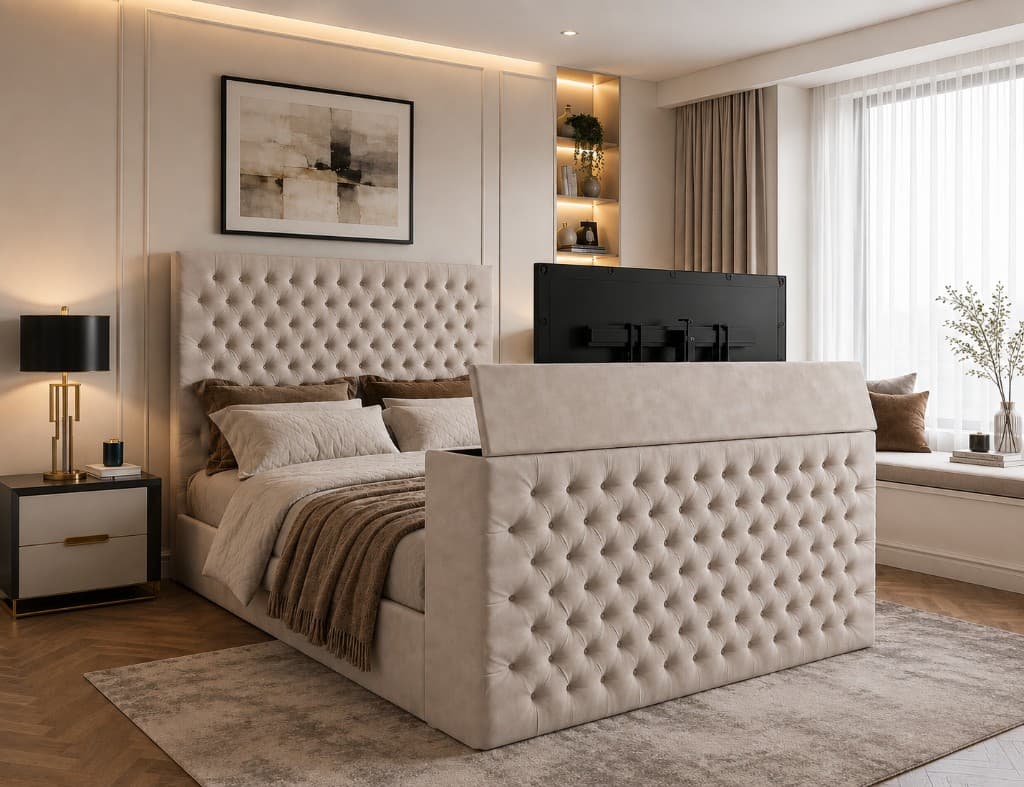
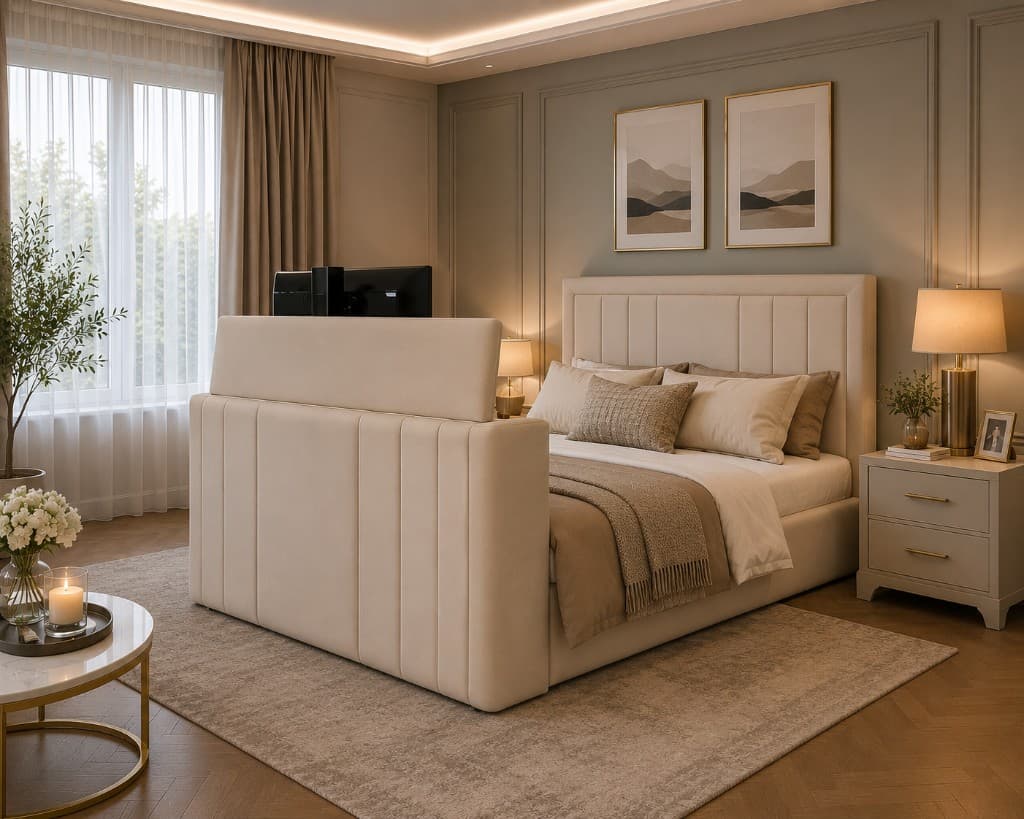
A TV bed — sometimes called a television bed or bed with built-in TV — hides your screen inside the footboard until you want to watch. At the touch of a button, the lift mechanism raises the television to viewing height and lowers it again when you are finished.
That sounds straightforward, but buying one involves more than choosing a fabric. You need to know whether a television is included, whether your existing TV will fit, how much room the complete frame requires and how you will route power, HDMI and aerial cables.
This TV bed buying guide walks through compatibility, UK bed sizes, storage options, connections and practical installation checks. Specifications vary between models, so treat general advice as a starting point and confirm details on each product page before ordering.
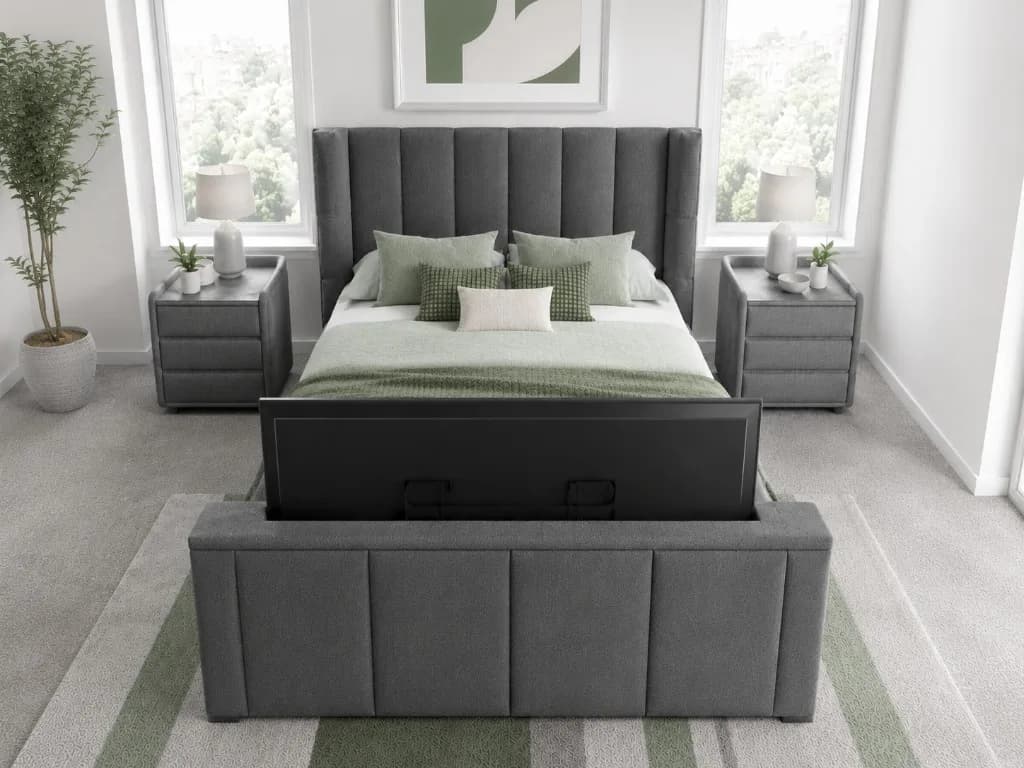
What is a TV bed?
A TV bed is an upholstered bed frame with a motorised or mechanical television lift built into the footboard. When the screen is not in use, it sits flat inside the compartment so the bed looks like a normal fabric bed. When you want to watch, the lift raises the TV to face the mattress.
TV beds are popular in UK master bedrooms, guest rooms and rental properties where wall mounting is undesirable or not permitted. Some models combine the television lift with ottoman storage under the mattress; others focus purely on concealed entertainment.
Luxury TV beds and smart TV beds are marketing descriptions rather than separate product categories — the important distinction is whether the listing includes a television, what size screen it accepts and which additional features that particular model offers.
How does a TV bed work?
An electric TV bed uses a motor housed in the footboard to move a platform that carries the television. A remote-control TV bed typically lowers the screen flush with the footboard surface and raises it to a preset viewing angle. Cables run through channels inside the frame so HDMI, power and aerial leads can stay connected while the TV moves.
The TV bed lift mechanism must balance the weight of your television. That is why maximum screen size, depth and weight limits are published per model rather than as a single universal rule. Overloading the lift or fitting an incompatible mount can strain the motor or prevent smooth operation.
Ventilation gaps in the compartment allow airflow around the electronics when the screen is stowed. Do not block these openings with cables or storage items.
Is a TV included with a TV bed?
Not every listing includes a television. Bedwick offers frame-only TV beds where you supply a compatible screen, and some products may offer an optional television at checkout. Always read the product title, description and configuration options before assuming a TV is part of the order.
| Package type | What you receive | Television | Typical use |
|---|---|---|---|
| Bed frame only | Upholstered TV bed frame with lift mechanism | Not included — supply your own compatible TV | You already own a suitable television or want to choose one separately |
| Bed with optional TV | Frame plus an optional television add-on at checkout | May be available as an upgrade depending on the product | You want one order but flexibility over screen specification |
| TV included | Frame and television supplied together | Included where stated on the product listing | You want a matched package without sourcing the screen separately |
| Complete package | Frame, television and sometimes mattress or accessories | Included only when explicitly listed | Furnishing a room from scratch in one purchase |
If you are comparing prices, check whether each quote is for the frame only or a TV included package. A cheaper frame-only price may rise once you add a compatible television separately.
Can you use your existing television in a TV bed?
Often yes — a TV bed without TV supplied is designed for you to mount your own compatible screen. Success depends on physical fit, not just the diagonal size printed on the box. Measure your television carefully and compare every dimension with the bed specification.
Before ordering, confirm:
- The TV fits within the maximum width, height and depth limits
- The weight without stand is within the stated maximum
- The VESA mounting pattern matches the bed bracket
- The factory stand can be removed if it adds unwanted depth
- HDMI and power sockets are reachable once the TV is mounted
If your current television is too deep, too heavy or uses an unusual VESA pattern, you may need a slimmer replacement rather than forcing an incompatible screen into the footboard.
What does VESA mean?
VESA is the standard spacing of mounting holes on the back of a flat-screen television, measured in millimetres — for example 200 × 200 or 400 × 400. A VESA mount TV bed includes a bracket designed for specific VESA sizes listed on the product page.
The pattern must match exactly. Adapters exist for some combinations, but relying on adapters inside a moving lift compartment is risky unless the manufacturer approves them. Check both the TV manual and the bed specification.
Mounting-hole position also matters: holes set very low or very high on the TV back can affect balance on the lift platform. When in doubt, contact Bedwick with your TV model number before purchase.
What size TV fits a TV bed?
TV bed compatibility is about physical dimensions and weight, not marketing screen size alone. A 43-inch television from one brand can be wider or deeper than a 43-inch model from another because of bezel and speaker design.
Screen width, how to measure a television and the diagonal limits stated on current listings are covered in the TV-bed screen compatibility guide.
| Check | Why it matters | What to confirm |
|---|---|---|
| Diagonal screen size | Marketing size does not guarantee a physical fit | Maximum diagonal quoted on the bed product page |
| Overall width | Bezel width varies between brands | TV width versus internal footboard opening |
| Overall height | Affects clearance when the screen is raised | TV height with and without stand removed |
| Depth without stand | Compartment depth is limited | Slimmest depth of the TV body once the stand is removed |
| Weight without stand | Lift motors and mounts have limits | Maximum TV weight stated for that bed model |
| VESA mounting pattern | Mounting holes must align with the bed bracket | VESA size and hole spacing on both TV and bed |
| Mounting-hole position | Hole height affects balance on the lift | Whether the TV’s VESA points sit within the allowed zone |
| Removable stand | Stands often add height and depth | Whether the factory stand can be removed safely |
| Port locations | Cables need room to bend inside the footboard | Side/rear HDMI and power socket positions |
| Ventilation | Electronics need airflow when concealed | Ventilation gaps specified by the manufacturer |
What TV bed size should you choose?
TV beds follow standard UK mattress sizes — single, small double, double, king and super king. The mattress size determines sleeping space; the outer frame, headboard and footboard will be larger.
| UK mattress size | Dimensions | Feet and inches |
|---|---|---|
| Single | 90 × 190cm | 3ft × 6ft 3in |
| Small Double | 120 × 190cm | 4ft × 6ft 3in |
| Double | 135 × 190cm | 4ft 6in × 6ft 3in |
| King | 150 × 200cm | 5ft × 6ft 6in |
| Super King | 180 × 200cm | 6ft × 6ft 6in |
Compare sizes in our UK Bed Size Guide. A king-size TV bed or super king TV bed gives more sleeping width but also needs more floor space and a longer footboard for the lift mechanism.
Double TV bed and small double TV bed models suit guest rooms and tighter bedrooms, but still require foot-end clearance for the screen to rise. Match the bed size to the room before focusing on screen size.
How to measure your room for a TV bed
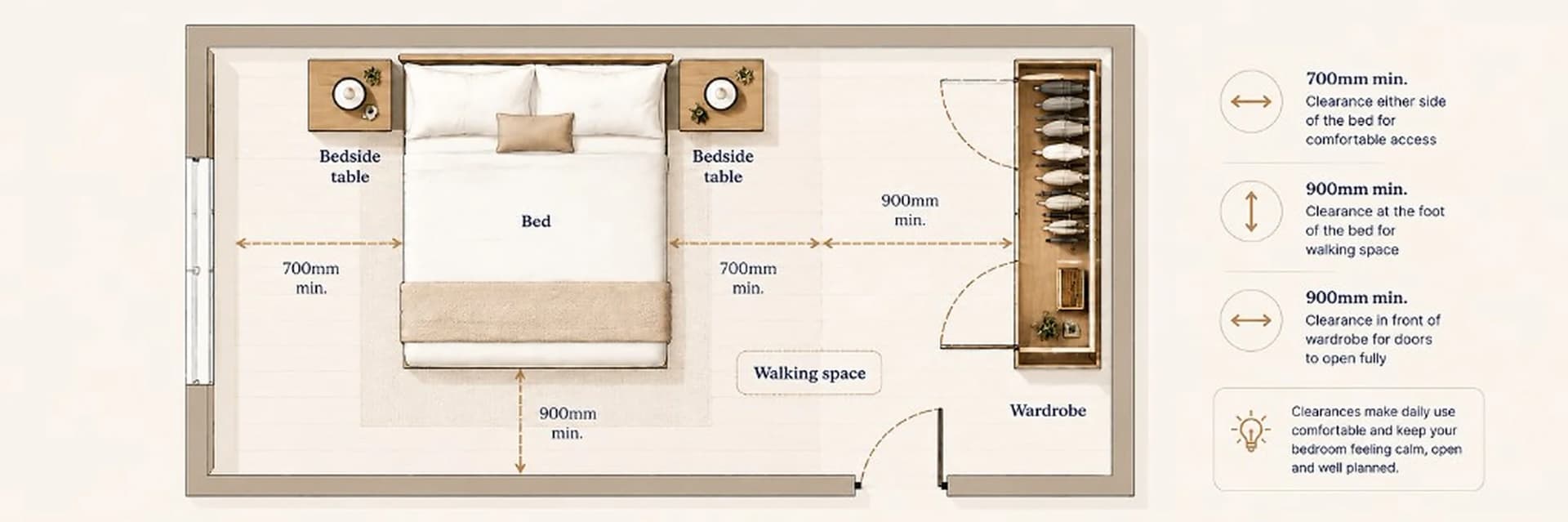
Measuring the mattress footprint alone is a common mistake. A TV bed for a small bedroom can feel cramped if the deeper footboard, raised screen and walking routes are not planned first.
Measure and note:
- Complete outer frame dimensions from the product page
- Clear space at the foot for the TV at full lift height
- Distance from the footboard to the opposite wall or furniture
- Door swings, radiators and bedside table placement
- Socket positions for the bed motor, TV and any set-top box
- Delivery route dimensions — stairs, turns and doorways
Remember the footboard
The footboard on a TV bed is deeper than a standard upholstered bed because it houses the lift. When you check the complete bed-frame footprint in the Bed Size and Room Planner, include that extra depth and the arc of the screen as it rises — not just the mattress rectangle.
What are the benefits of a TV bed?
The television disappears when you are not using it
A bed frame with TV integration keeps the screen out of sight when lowered. The room reads as a calm bedroom rather than a media zone — useful if you prefer not to see a black rectangle on the wall.
No separate television unit
You may avoid a standalone TV stand or media unit at the foot of the bed, freeing floor space. Cables can be routed inside the frame rather than trailing across the carpet.
No wall mounting
Renters and period properties often rule out drilling into walls. A TV bed delivers a similar viewing position without fixing a bracket to masonry or plasterboard.
Concealed cable management
Internal cable channels help HDMI, power and aerial leads stay tidy. Plan port access before final assembly — tight bends can damage connectors over time.
Entertainment from bed
The screen faces the mattress directly, which suits relaxed evening viewing. Pair with a compatible mattress from our Bedwick mattresses range for a complete setup.
Entertainment and storage in one frame
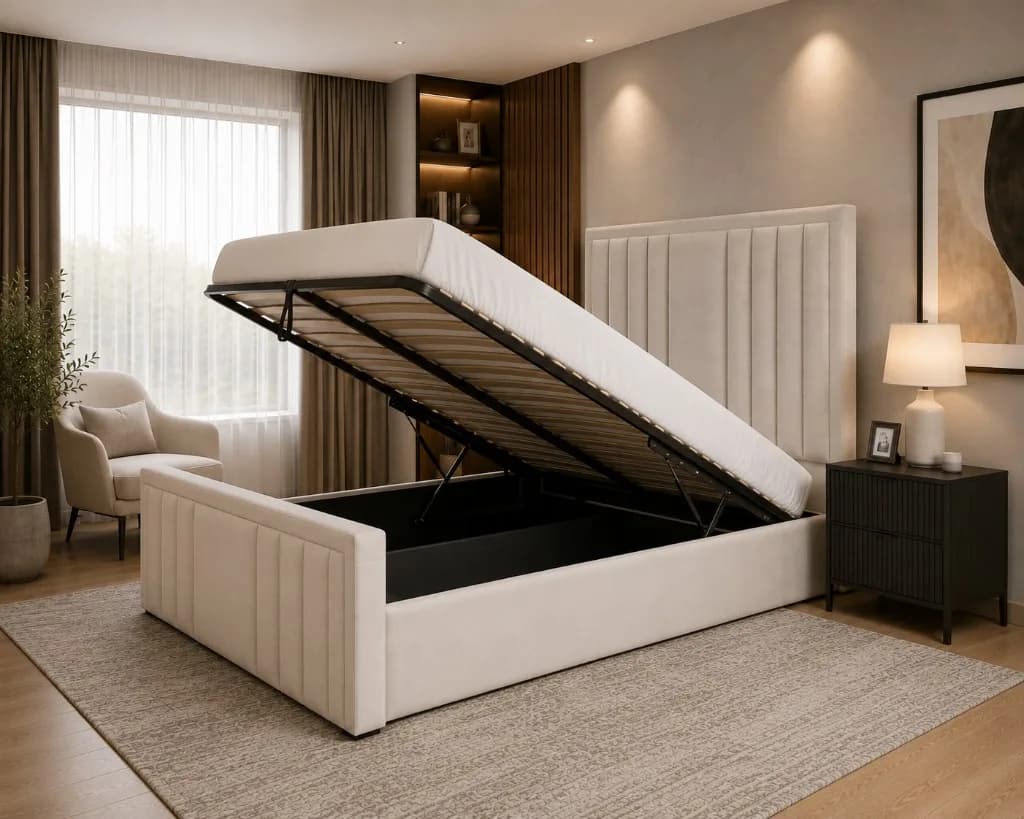
Selected ottoman TV bed models combine a television lift with gas-lift under-bed storage. That can solve two problems in one footprint where floor space is limited.
Are there disadvantages to TV beds?
TV beds are not the right answer for every bedroom. Consider these trade-offs honestly:
- Foot-end clearance — the screen needs space to rise without hitting a wall, radiator or furniture.
- Deeper footboard — the frame occupies more floor depth than a bed without a lift.
- Compatibility limits — not every television will fit; you must verify dimensions and VESA pattern.
- Power dependency — the lift requires electricity; behaviour during a power cut depends on the model.
- Assembly complexity — lift mechanisms and cabling take longer to set up than a standard divan.
- Feature variation — speakers, Bluetooth, USB ports and storage are not universal across the range.
Standard TV bed or ottoman TV bed?
A standard TV bed focuses on concealed television storage in the footboard. An ottoman TV bed adds gas-lift storage beneath the mattress platform — sometimes on the same model, depending on configuration. Compare the full TV beds collection, then narrow to ottoman TV beds, luxury TV beds or standard TV bed frames if you already know which emphasis you want.
| Comparison | Standard TV bed | Ottoman TV bed |
|---|---|---|
| Primary function | Concealed television at the foot of the bed | Television lift plus under-bed storage |
| Storage | Usually none beyond the TV compartment | Gas-lift ottoman compartment for bedding and bulk items |
| Footboard depth | Deeper to house the lift mechanism | Often deeper still to combine lift and storage |
| Lift clearance | Space needed at the foot for the screen to rise | Separate clearance for TV lift and ottoman platform |
| Best suited to | Entertainment-focused bedrooms without extra storage needs | Rooms that need both a hidden TV and concealed storage |
| Availability | Offered across several Bedwick TV bed models | Available on selected models — confirm on the product page |

For more on lift directions and storage organisation, see our Ottoman Bed Buying Guide.
Side-opening or end-opening ottoman storage?
On combined TV and ottoman models, storage opening direction matters as much as TV lift clearance. End-opening compartments need space at the foot; side-opening models need clearance on one long edge.
Not every ottoman TV bed offers both options. Confirm the storage configuration on the individual product page before choosing fabric and size. Use the Ottoman Bed Storage Calculator to estimate your ottoman storage space — this is an approximate planning estimate based on the dimensions selected. actual usable storage varies by bed design, internal structure and how items are packed.
Built-in speakers and audio systems
Some TV bed designs include built-in speakers or a soundbar in the footboard, and a Bluetooth TV bed may pair with external devices where that feature is listed. These are not standard on every model — check the product specification rather than assuming audio is integrated.
If no speakers are built in, plan to use the television’s own speakers or add a separate sound system elsewhere in the room. Verify whether Bluetooth audio affects lip-sync at your preferred volume before committing.
Can you connect Sky, Virgin or a streaming device?
A TV bed with HDMI connections routes the television like any other screen. Sky, Virgin, Freeview playboxes and streaming sticks (Fire TV, Apple TV, Chromecast) connect via HDMI to the TV, with power to each device.
Practical questions to resolve before assembly:
- Where will the set-top box or stick sit — nearby unit, shelf or bed compartment?
- Is there enough HDMI length and bend radius inside the frame?
- Can you reach ports for occasional reboots or pairing?
- Does the box need line-of-sight for its own remote?
Streaming apps built into a smart TV reduce the number of boxes required, but still depend on reliable Wi-Fi in the bedroom.
Can you connect a PlayStation or Xbox?
A gaming TV bed setup is usually possible via HDMI from console to television, the same as a wall-mounted screen. Latency depends on the TV and game mode settings, not the bed frame itself.
Consoles need ventilation and space beside or beneath the bed. Long HDMI runs and power cables should not obstruct the lift path. Plan controller charging within reach of the bed without trailing cables across walkways.
Power, aerials, Wi-Fi and cable planning
A TV bed with USB ports or multiple HDMI inputs is only helpful if you can reach those sockets during assembly and later maintenance. Map socket positions before the bed is fixed in place.
- Power — dedicated sockets for the bed motor and television; avoid overloading extension leads inside the frame.
- HDMI — measure cable runs from TV to console or set-top box; allow gentle bends.
- Aerial — if you use terrestrial TV, route the aerial lead before the footboard panels are closed.
- Wi-Fi — test signal strength at the bed position; mesh nodes may help smart TVs and streaming sticks.
What happens during a power cut?
If power is lost while the television is raised, the lift usually stops in position. Some mechanisms may allow manual lowering using a release procedure described in the instructions — others require power to return before the screen moves.
Do not force the platform by hand unless the manufacturer explicitly instructs you to. Keep the instruction manual accessible and test the remote lowering function after assembly while someone can assist if needed.
Are TV beds safe?
TV beds are safe when assembled correctly, loaded within specified television weight limits and used as intended. Treat the moving platform with the same care you would give any motorised furniture.
- Keep fingers, pets and objects clear while the lift moves
- Do not exceed the maximum TV weight for your model
- Ensure ventilation openings remain unobstructed
- Stop using the lift if it strains, judders or stops mid-travel
- Keep liquids away from electronics in the footboard
- Supervise children around the mechanism
Anti-trap features and manual lowering vary by product — confirm what your chosen model offers rather than assuming a particular safety kit is included.
Does a TV bed need a special mattress?
You do not usually need a dedicated “TV bed mattress”, but size and base compatibility still matter. Match the UK mattress size to the frame and choose sprung slats or a solid platform according to the mattress manufacturer’s guidance.
On ottoman TV bed models, mattress weight can affect lifting effort for the storage platform. Our Mattress Buying Guide explains firmness, construction and base pairing in more detail.
Choosing the right fabric and design
An upholstered TV bed or fabric TV bed is chosen like any other Bedwick frame — headboard shape, fabric texture and colour should suit the room. Order free Bedwick fabric samples if you are deciding between shades at home.

Can the television be replaced later?
Yes — that is one reason to record the bed’s maximum TV dimensions when you first install it. When you replace the television, verify the new model’s width, depth, weight and VESA pattern against the same limits.
Slimmer, lighter screens are often easier to lift. If you upgrade to a much larger diagonal size, check whether it still fits the footboard compartment at rest and at full extension.
Delivery and assembly checklist
TV beds arrive in multiple cartons with the lift mechanism, footboard components and upholstery elements. Review our delivery information for lead times and regional coverage before ordering.
Before delivery day, confirm:
- Access route dimensions for cartons and assembled sections
- Socket positions for the motor and television are planned
- Your compatible TV is available if the bed is frame-only
- VESA fixings and screws suited to your TV are ready
- Cable lengths for HDMI, power and aerial are sufficient
- Room layout is final — moving a assembled TV bed is difficult
- You have help for two-person assembly steps
- Instruction manuals are kept for future TV replacement
If you have questions about assembly or a missing part, contact Bedwick before forcing misaligned components. Warranty and returns terms are set out in our returns policy.
TV bed versus a wall-mounted television
Both options put a screen in front of the mattress, but the installation and room appearance differ. A TV bed versus wall-mounted TV comparison often comes down to rental restrictions, cable routing and whether you want the screen hidden.
| Comparison | TV bed | Wall-mounted television |
|---|---|---|
| Screen position | Rises from the footboard when you want to watch | Fixed on the wall opposite or beside the bed |
| Room appearance | Television hidden when lowered | Screen visible even when switched off |
| Installation | Bed delivery and assembly; TV fitted to the bed mount | Wall fixing, cable chasing or trunking often required |
| Viewing angle | Screen faces the mattress directly | Depends on mount height and bed position |
| Rental properties | No structural wall changes needed | Landlord permission may be required for fixing |
| Storage | Some models add ottoman storage | No integrated bedroom storage from the mount itself |
Is a TV bed worth it?
Are TV beds worth it? They suit bedrooms where you watch from bed regularly, want the screen concealed and have adequate foot-end clearance. They are less ideal if you rarely use a bedroom TV, lack space for the lift arc or need a screen visible from other parts of the room.
Use the Bed Size & Room Planner to test layout before committing — it is the fastest way to avoid ordering a frame that fits the mattress but not the room.
Your TV bed buying checklist
Before placing an order, confirm:
- Whether a television is included or frame-only
- TV size, depth, weight and VESA compatibility
- Complete bed-frame dimensions and foot-end clearance
- UK mattress size and base type suitability
- Power, HDMI and aerial routing plan
- Console or set-top box placement if required
- Whether you need ottoman storage on the same frame
- Fabric, headboard and colour choice
- Delivery access and assembly support
- Product-specific features — speakers, Bluetooth, ports — where listed
Explore Bedwick TV beds
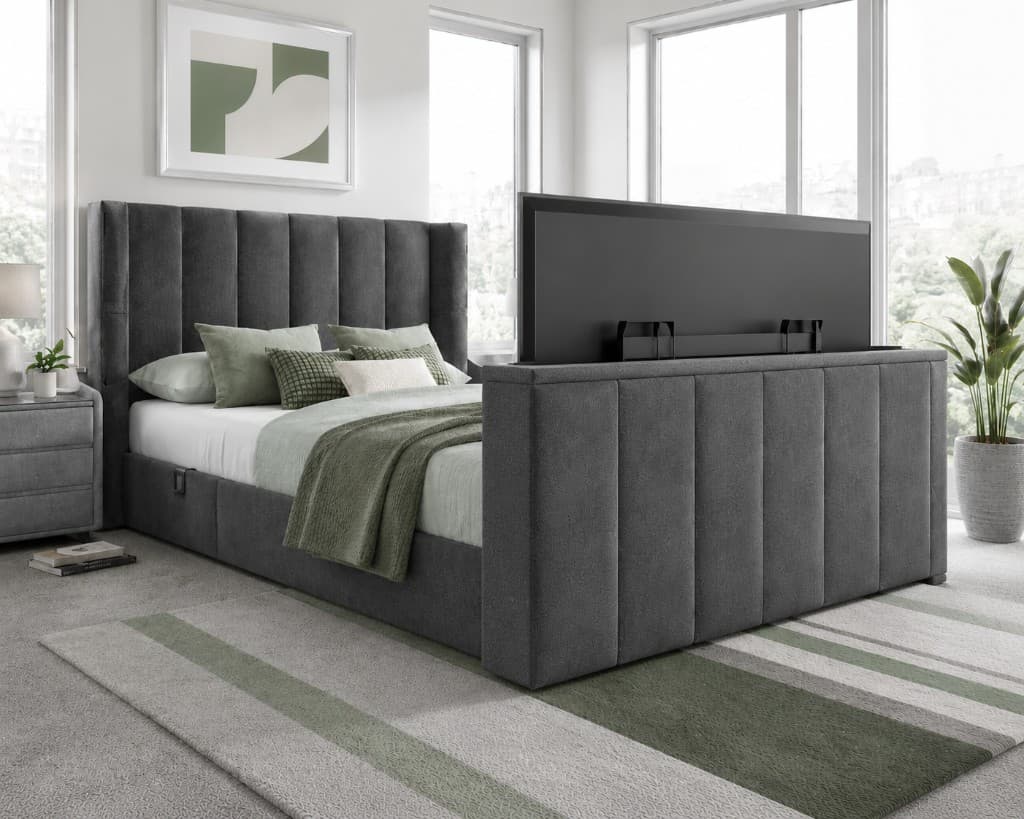
Explore Bedwick TV beds in a choice of UK sizes, upholstery options and storage configurations. Check each product page for its included technology, supported television dimensions and available configurations.
Shop TV Beds
Ready to shop?
Compare TV beds by size and configuration, then verify television compatibility on each product page before checkout.
Frequently asked questions
A motorised or mechanical lift housed in the footboard lowers the television flat inside the bed when you are not watching and raises it to viewing height when you want to use it. Operation is usually via remote control, depending on the model.
Not always. Some listings are frame-only and expect you to supply a compatible television. Others offer an optional or included screen — check the product page and checkout options for the specific bed you are buying.
Often yes, provided the TV’s size, depth, weight and VESA mounting pattern fit the bed’s specification. Measure your television and compare it with the limits published on the product page before ordering.
There is no single answer for every model. Each bed lists maximum diagonal size and physical dimensions the footboard can accept. Confirm width, height, depth and weight — not just the screen size printed on the box.
VESA describes the spacing of the threaded mounting holes on the back of a television, written as horizontal × vertical millimetres — for example 200 × 200. The bed’s bracket must match the TV’s VESA pattern for a secure fit.
Yes, where the physical dimensions and VESA pattern are compatible. Smart functions still depend on your Wi-Fi signal in the bedroom and access to power and HDMI ports inside the footboard.
Usually via HDMI from the console to the television, but cable routing space and socket access vary by model. Plan where the console will sit and how cables will reach the TV before assembly.
Set-top boxes are normally placed in a nearby unit, on a shelf or in a ventilated compartment if the bed design provides one. HDMI leads run from the box to the TV. Confirm cable length and access on your chosen model.
Some TV bed designs include integrated speakers or soundbars, but this is not universal across the range. Rely on the television’s own speakers unless the product specification states otherwise.
Standard TV beds focus on the television compartment. Selected Bedwick models also offer ottoman gas-lift storage under the mattress — check the product tags and storage options on each listing.
You need the correct UK mattress size and a base type compatible with your chosen mattress — sprung slats or a solid platform. Depth and weight can also matter on ottoman models. See our Mattress Buying Guide for general guidance.
They are more involved than a standard bed frame because of the lift mechanism and cabling. Many customers prefer professional assembly. Follow the supplied instructions and contact Bedwick if parts do not align as expected.
Behaviour depends on the mechanism. Many lifts stop in position when power is lost; some models may allow manual lowering — check the manufacturer’s guidance for your specific bed rather than forcing the mechanism.
Yes, provided the replacement TV meets the same physical and VESA compatibility limits. Keep a record of the bed’s maximum dimensions so you can compare future televisions.
They suit bedrooms where you want entertainment without a visible wall-mounted screen and where the footboard lift path fits your layout. If you rarely watch television in bed or lack foot-end clearance, a standard bed and separate screen may be simpler.
Plan your room, then choose your TV bed
The right TV bed fits your television, your mattress and your bedroom layout. Start with measurements in the UK Bed Size Guide, then compare models on the TV beds category page.